
Moon Springs

Remembering My Grandparents

I was quite close to my grandparents. By virtue of being the eldest of the four grandchildren (and being a boy!), I not only received a lot of affection but also got more opportunities to interact with them. Throughout my childhood days they lived in Agra where my grandfather practiced as a lawyer after a long stint with the local administration (collectorate). Most of my summer vacations then were spent in Agra. I often went there alone as I was considered to be old enough to travel independently.  I enjoyed those days tremendously with all the attention showered on me. They moved in with us in Jaipur around the time I joined college. It was nice to have them despite the intermittent clash of generations. I realize today that the process of getting to know   my grandparents is an ongoing one that still continues after so many years of their passing away.

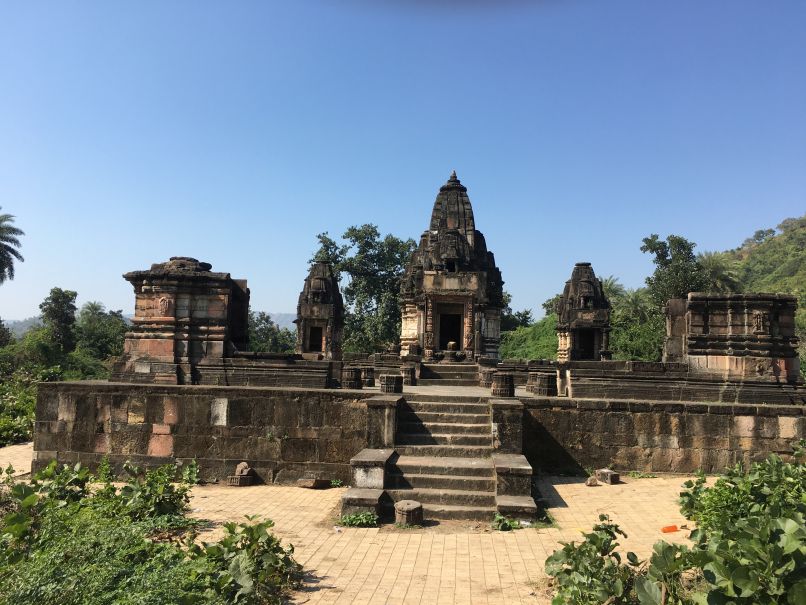
Lakhena Temple ruins, Polo Forest, Vijaynagar, Gujarat, India. November 16, 2020.

In Agra my grandparents lived in a locality that was vacated by people who migrated to Pakistan at the time of partition. In fact, the house where they stayed was arranged for my grandfather by the local administration as he was involved in the allocation of houses to those who came from the other side of the border. Someone was needed in the vicinity to supervise things. They lived in the same house on rent till they moved to Jaipur. Part of the house was used as a shoe factory before partition. This part was never used for living as it had no ventilation or light. Even in the 1970s when we ventured into these dark rooms as brave kids, we would find firmas (shoe-lasts) lying around. My grandfather rarely talked about those days except for saying that they were some of the most difficult days for him during his life in the local administration.  Many people who were allocated houses in that locality became my grandfather’s lifelong friends and visited us very often. I do not remember a single instance of their discussing the trauma of partition while I do remember a few occasions when they laughed about the confusion of those times.

My grandmother was a very religious person and a great believer of Hindu religious customs. Not only were all the religious festivals celebrated with gusto, the morning puja (worship) and the evening aarti (incense or light offered to deity) were part of her daily routine. As kids we were not required to join her in the morning puja but singing along with her at the time of the aarti with folded hands and closed eyes was mandatory. As we grew older, we could avoid active participation in the aarti but she felt very good if we did join her. While she did not mind going to a temple once in a while, my grandmother’s God essentially resided in the house. As she grew older, she spent more and more time with the prayer beads, reciting Ram naam (praying for God Ram)

My grandfather was also quite religious, but less ritualistic. He never joined the evening aarti or the morning puja and I do not remember him ever going to a temple. After the aarti was over, my grandmother always brought the diya (lamp) to bless him with it. This he accepted with reverence. Every day he wrote 786 in Arabic several times while reciting (almost mumbling) the kalima. (declaration of faith in Allah and Mohammed as his messenger). One often saw him with the tasbeeh (rosary) reciting aayats (verses from the Holy Quran).  In Agra a fakir (religious ascetic) from a nearby dargah (tomb of a Muslim saint) visited him often. I never understood what they discussed but he often brought a taveez (amulet or charm) which my grandfather tied on his arm or gave to his brother who was ailing. At times money changed hands for a special dua (prayer or invocation) at the dargah. My grandmother never complained about the non-participation of my grandfather in her everyday pujas but was not very happy with the visits of this fakir as she was not convinced of his genuineness. The only thing common between the daily religious routines of my grandparents was the prayer beads that they shared. Once in a while both of them would also say the same phrase aloud:

Tu karam kar de to beda paar hai!

(If God is generous, then all is well).
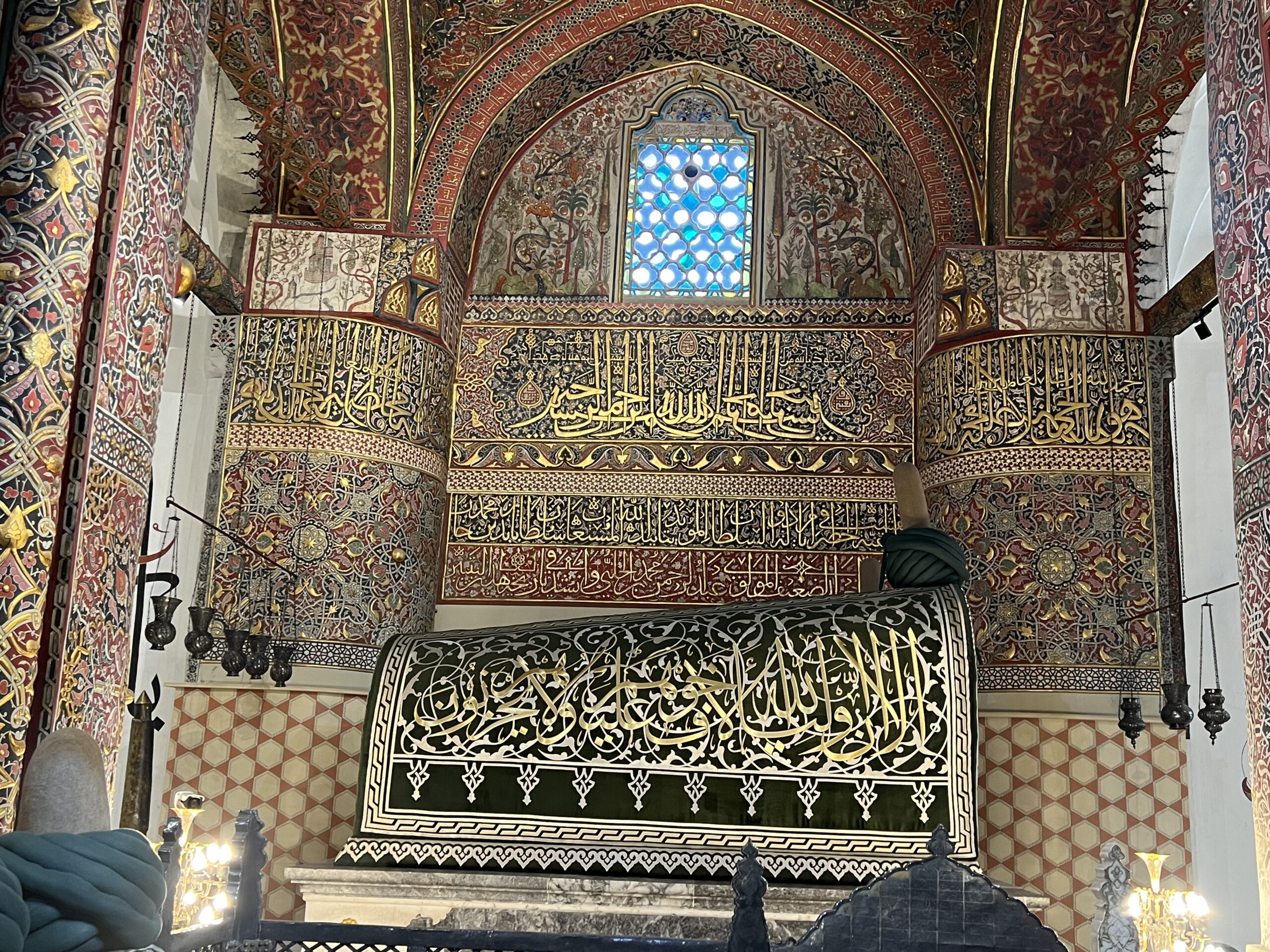
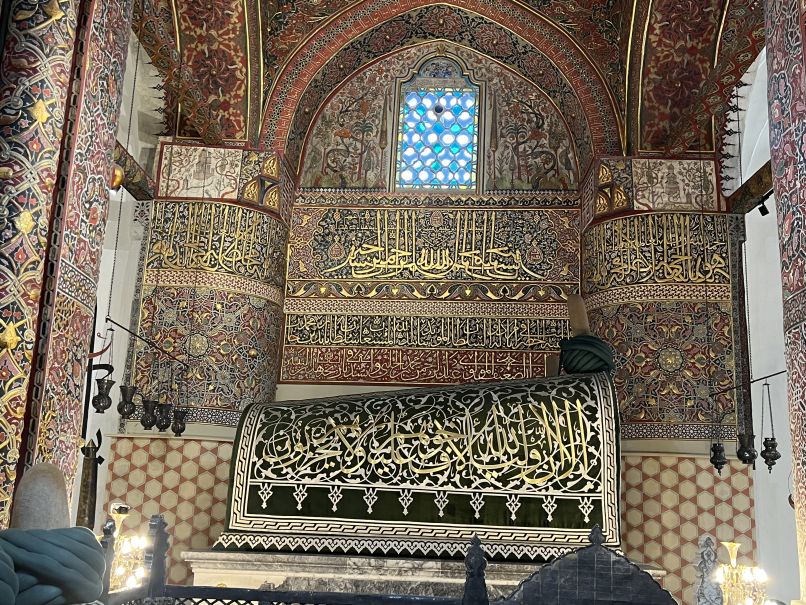
Tomb of the Sufi saint and poet, Rumi. Konya, Turkey. June 7, 2024.

I understand that they had inherited this phrase from my great grandfather who was a reasonably well-known Sufi poet and was invited to Ajmer every year at the time of the Urs (annual festival at the Sufi saint Khwaja Garib Nawaz dargah).

Despite these significant differences in the daily religious routines, my grandparents actively participated together in two pujas during the year. One was Laxmi puja at the time of Diwali and the other was kalam-dawat ki puja (worship of pen and inkpot) at the time of bhai dooj. In many respects the latter was much more elaborate in our household. Everybody brought their writing instruments along with inkpots (till they were in use). Kalavas (sacred threads) were tied to each of these and all of us were expected to write something with them on a large sheet of paper and then put some kumkum (red turmeric powder) and akshat (rice). Typically, my grandfather wrote something in Arabic, Urdu or Persian. My grandmother almost always wrote Aum Namah Shivai (I bow down to Lord Shiva). Depending on who else was around, other elders in the household wrote different things in English, Hindi, Urdu or even Sanskrit.  As small kids we were satisfied with signing our names with a flourish. But as we grew older, we also experimented. On different occasions, I remember writing lines from      Tagore’s ‘where mind is without fear’ (Visit Here) and even a few from Madhushala! (Visit Here). All this was allowed and encouraged. After the festival, this symbol of diversity within the household was to be found in my grandmother’s puja place for some time. For some more time it floated around in other places in the house and then disappeared to be created once again next year!

The clients of my grandfather came from diverse backgrounds. Since he only did civil cases, we never got to see those who were charged with robbery, arson or murder! But even among the civil clients the variety was fairly interesting. Many of these clients were Muslims. Given the vagaries of our legal system the interaction with these clients was spread over months and even years. I got to know a few of them rather well during my trips in summers. In retrospect, the evolution of the relationship between my grandmother and one of these Muslim clients seems fascinating.

We all used to call him machliwale uncle, partly because he worked with the fisheries department but mainly because he brought fresh fish whenever he came to visit my grandfather! His case took years. Initially he would talk business and go away. In the second phase my grandmother started to serve him tea but he had a separate cup which he washed outside after he finished his tea. In a subsequent visit to our grandparents’ house, I noticed that my grandmother had started to serve him food. He got the same food as we ate but he was served in Chinaware while we ate in metal plates. He continued to wash his plates outside. As the case progressed, he started to eat in the same plates which we used and slept outside on the verandah (he came from a place near Agra). And his plates also got washed along with all the other vessels. Machliwale uncle eventually won the case and remained in touch with us for several years even after my grandparents left Agra. Initially, I used to think that this transition from being an ‘outsider’ to an ‘insider’ took so much time because he was a Muslim. That may have been partly true but I also saw a somewhat similar process at work with a Hindu client who later became an apprentice of my grandfather.

I do not know much about my grandmother’s growing up but my grandfather’s childhood and education was done in Jaipur where my great-grandfather worked. They lived in a mixed locality where both Hindus and Muslims resided. Later that part of the Jaipur city became predominantly Muslim and my grandfather moved to the state of Uttar Pradesh for work. My great grandfather’s kothi where my grandfather grew up was given on rent to a Muslim tenant. My grandmother always talked about the that-baat (grandiose living) that she enjoyed as a daughter-in-law in that house. Since my father worked in Jaipur and my grandparents visited us often, I got to meet many of their old neighbours. My grandparents were particularly fond of one person whom we called Guphera Bua. She was a muhboli behen (sworn sister) of my grandfather. She and her family did small embroidery work but their main source of income was making nadas (draw-strings) of different kinds. Our home supplies of nadas came for them! I remember participating in the wedding celebrations of her daughter and enjoying the lovely food.

I was not particularly surprised when my grandparents did not object to my marriage to a person who was very different from ‘us’ in every respect – language, region and religion. They did not even insist on a Hindu wedding when we decided to get married under the Special Marriages Act. The irony was that the Registrar of Marriages tried to persuade us to marry under the Arya Samaj rites! If there were any misgivings, and I am sure there must have been many, they were not aired in my presence. But I still remember very vividly the joy on my grandmother’s face when we came home after the wedding. She came running, embraced me and said ‘I can talk to Bahu, (daughter-in-law). She understands Hindi!’ I then realized that one of her major fears was that she will not be able to communicate with her grand-daughter-in-law! And she behaved as if nothing else mattered. 

A passion that both grandparents shared was for education. They used every opportunity to convey to us the importance of education. My grandfather tried to teach me Urdu but I could not move beyond the alphabets. As I studied more, my grandparents’ joy knew no bounds. During one of my trips to Agra my grandfather was unwell and he had to write an appeal for a case. I told him that he can dictate and I will write. He was not very sure that I could manage but I insisted. So, he dictated a long appeal and I wrote for hours together and it was subsequently typed. I could manage the job without making too many mistakes. While my grandfather was pleased with my effort, my grandmother was ecstatic. For her, taking dictation from my grandfather at such a young age was a great achievement. Her benchmarks were straightforward – her father-in-law, her husband and her son! I still remember what she told me that day: ‘as you study more, don’t forget that I taught you the alphabets and the numbers’! She never let me forget that throughout her life! But there was no reason for her to do that as the childhood memories of playing with her and getting to know the numbers and the alphabets are still fresh in my mind. She would throw a potato towards me and say ‘ONE…’, and then an onion would follow along with ‘TWO…’ and so on. If we saw a peacock in the backyard, she will immediately ask me, ‘P for…’! She could any day put a well-trained Montessori teacher to shame! Once in a while she would confide in me and say that she wanted to study more. She could manage Hindi, some Urdu and a bit of English and was quite proud of the fact that she wrote letters to her son (who hardly knew Hindi) in Roman – Hindi words written with English alphabets. Anyway, my ability to take dictation became part of the ‘folklore’ that my grandmother insisted on repeating to everybody who came her way for many years. It was very embarrassing for me but a source of great joy for her.

My grandparents were full of stories about the olden days – the days of glory, hardships and transitions that the family had gone through. One theme that found place in these narrations often, related to the fact that nobody was corrupt in the family despite being in positions with unlimited opportunities for making money on the side. For my grandmother the links were very clear and logical; since nobody in the family was corrupt, there were no assets to play around with and education was the only hope!

The oft repeated phrase of my grandmother still rings in my ears. Her lessons were simple and straightforward:

‘Apne kaam se beimaani aur anna ka apmaan kabhi mat karna!’

(Never be dishonest in your work and disrespect food)

Not surprisingly, myself and my siblings have fully internalized these values. I really miss that simplicity and the ability to communicate. I miss them!

Originally written in the year 2008

In Agra my grandparents lived in a locality that was vacated by people who migrated to Pakistan at the time of partition. In fact, the house where they stayed was arranged for my grandfather by the local administration as he was involved in the allocation of houses to those who came from the other side of the border. Someone was needed in the vicinity to supervise things. They lived in the same house on rent till they moved to Jaipur. Part of the house was used as a shoe factory before partition. This part was never used for living as it had no ventilation or light. Even in the 1970s when we ventured into these dark rooms as brave kids, we would find firmas (shoe-lasts) lying around. My grandfather rarely talked about those days except for saying that they were some of the most difficult days for him during his life in the local administration.  Many people who were allocated houses in that locality became my grandfather’s lifelong friends and visited us very often. I do not remember a single instance of their discussing the trauma of partition while I do remember a few occasions when they laughed about the confusion of those times.

My grandmother was a very religious person and a great believer of Hindu religious customs. Not only were all the religious festivals celebrated with gusto, the morning puja (worship) and the evening aarti (incense or light offered to deity) were part of her daily routine. As kids we were not required to join her in the morning puja but singing along with her at the time of the aarti with folded hands and closed eyes was mandatory. As we grew older, we could avoid active participation in the aarti but she felt very good if we did join her. While she did not mind going to a temple once in a while, my grandmother’s God essentially resided in the house. As she grew older, she spent more and more time with the prayer beads, reciting Ram naam (praying for God Ram)

My grandfather was also quite religious, but less ritualistic. He never joined the evening aarti or the morning puja and I do not remember him ever going to a temple. After the aarti was over, my grandmother always brought the diya (lamp) to bless him with it. This he accepted with reverence. Every day he wrote 786 in Arabic several times while reciting (almost mumbling) the kalima. (declaration of faith in Allah and Mohammed as his messenger). One often saw him with the tasbeeh (rosary) reciting aayats (verses from the Holy Quran).  In Agra a fakir (religious ascetic) from a nearby dargah (tomb of a Muslim saint) visited him often. I never understood what they discussed but he often brought a taveez (amulet or charm) which my grandfather tied on his arm or gave to his brother who was ailing. At times money changed hands for a special dua (prayer or invocation) at the dargah. My grandmother never complained about the non-participation of my grandfather in her everyday pujas but was not very happy with the visits of this fakir as she was not convinced of his genuineness. The only thing common between the daily religious routines of my grandparents was the prayer beads that they shared. Once in a while both of them would also say the same phrase aloud:

Tu karam kar de to beda paar hai!

(If God is generous, then all is well).

I understand that they had inherited this phrase from my great grandfather who was a reasonably well-known Sufi poet and was invited to Ajmer every year at the time of the Urs (annual festival at the Sufi saint Khwaja Garib Nawaz dargah).

Despite these significant differences in the daily religious routines, my grandparents actively participated together in two pujas during the year. One was Laxmi puja at the time of Diwali and the other was kalam-dawat ki puja (worship of pen and inkpot) at the time of bhai dooj. In many respects the latter was much more elaborate in our household. Everybody brought their writing instruments along with inkpots (till they were in use). Kalavas (sacred threads) were tied to each of these and all of us were expected to write something with them on a large sheet of paper and then put some kumkum (red turmeric powder) and akshat (rice). Typically, my grandfather wrote something in Arabic, Urdu or Persian. My grandmother almost always wrote Aum Namah Shivai (I bow down to Lord Shiva). Depending on who else was around, other elders in the household wrote different things in English, Hindi, Urdu or even Sanskrit.  As small kids we were satisfied with signing our names with a flourish. But as we grew older, we also experimented. On different occasions, I remember writing lines from      Tagore’s ‘where mind is without fear’ (Visit Here) and even a few from Madhushala! (Visit Here). All this was allowed and encouraged. After the festival, this symbol of diversity within the household was to be found in my grandmother’s puja place for some time. For some more time it floated around in other places in the house and then disappeared to be created once again next year!

The clients of my grandfather came from diverse backgrounds. Since he only did civil cases, we never got to see those who were charged with robbery, arson or murder! But even among the civil clients the variety was fairly interesting. Many of these clients were Muslims. Given the vagaries of our legal system the interaction with these clients was spread over months and even years. I got to know a few of them rather well during my trips in summers. In retrospect, the evolution of the relationship between my grandmother and one of these Muslim clients seems fascinating.

We all used to call him machliwale uncle, partly because he worked with the fisheries department but mainly because he brought fresh fish whenever he came to visit my grandfather! His case took years. Initially he would talk business and go away. In the second phase my grandmother started to serve him tea but he had a separate cup which he washed outside after he finished his tea. In a subsequent visit to our grandparents’ house, I noticed that my grandmother had started to serve him food. He got the same food as we ate but he was served in Chinaware while we ate in metal plates. He continued to wash his plates outside. As the case progressed, he started to eat in the same plates which we used and slept outside on the verandah (he came from a place near Agra). And his plates also got washed along with all the other vessels. Machliwale uncle eventually won the case and remained in touch with us for several years even after my grandparents left Agra. Initially, I used to think that this transition from being an ‘outsider’ to an ‘insider’ took so much time because he was a Muslim. That may have been partly true but I also saw a somewhat similar process at work with a Hindu client who later became an apprentice of my grandfather.

I do not know much about my grandmother’s growing up but my grandfather’s childhood and education was done in Jaipur where my great-grandfather worked. They lived in a mixed locality where both Hindus and Muslims resided. Later that part of the Jaipur city became predominantly Muslim and my grandfather moved to the state of Uttar Pradesh for work. My great grandfather’s kothi where my grandfather grew up was given on rent to a Muslim tenant. My grandmother always talked about the that-baat (grandiose living) that she enjoyed as a daughter-in-law in that house. Since my father worked in Jaipur and my grandparents visited us often, I got to meet many of their old neighbours. My grandparents were particularly fond of one person whom we called Guphera Bua. She was a muhboli behen (sworn sister) of my grandfather. She and her family did small embroidery work but their main source of income was making nadas (draw-strings) of different kinds. Our home supplies of nadas came for them! I remember participating in the wedding celebrations of her daughter and enjoying the lovely food.

I was not particularly surprised when my grandparents did not object to my marriage to a person who was very different from ‘us’ in every respect – language, region and religion. They did not even insist on a Hindu wedding when we decided to get married under the Special Marriages Act. The irony was that the Registrar of Marriages tried to persuade us to marry under the Arya Samaj rites! If there were any misgivings, and I am sure there must have been many, they were not aired in my presence. But I still remember very vividly the joy on my grandmother’s face when we came home after the wedding. She came running, embraced me and said ‘I can talk to Bahu, (daughter-in-law). She understands Hindi!’ I then realized that one of her major fears was that she will not be able to communicate with her grand-daughter-in-law! And she behaved as if nothing else mattered. 

A passion that both grandparents shared was for education. They used every opportunity to convey to us the importance of education. My grandfather tried to teach me Urdu but I could not move beyond the alphabets. As I studied more, my grandparents’ joy knew no bounds. During one of my trips to Agra my grandfather was unwell and he had to write an appeal for a case. I told him that he can dictate and I will write. He was not very sure that I could manage but I insisted. So, he dictated a long appeal and I wrote for hours together and it was subsequently typed. I could manage the job without making too many mistakes. While my grandfather was pleased with my effort, my grandmother was ecstatic. For her, taking dictation from my grandfather at such a young age was a great achievement. Her benchmarks were straightforward – her father-in-law, her husband and her son! I still remember what she told me that day: ‘as you study more, don’t forget that I taught you the alphabets and the numbers’! She never let me forget that throughout her life! But there was no reason for her to do that as the childhood memories of playing with her and getting to know the numbers and the alphabets are still fresh in my mind. She would throw a potato towards me and say ‘ONE…’, and then an onion would follow along with ‘TWO…’ and so on. If we saw a peacock in the backyard, she will immediately ask me, ‘P for…’! She could any day put a well-trained Montessori teacher to shame! Once in a while she would confide in me and say that she wanted to study more. She could manage Hindi, some Urdu and a bit of English and was quite proud of the fact that she wrote letters to her son (who hardly knew Hindi) in Roman – Hindi words written with English alphabets. Anyway, my ability to take dictation became part of the ‘folklore’ that my grandmother insisted on repeating to everybody who came her way for many years. It was very embarrassing for me but a source of great joy for her.

My grandparents were full of stories about the olden days – the days of glory, hardships and transitions that the family had gone through. One theme that found place in these narrations often, related to the fact that nobody was corrupt in the family despite being in positions with unlimited opportunities for making money on the side. For my grandmother the links were very clear and logical; since nobody in the family was corrupt, there were no assets to play around with and education was the only hope!

The oft repeated phrase of my grandmother still rings in my ears. Her lessons were simple and straightforward:

‘Apne kaam se beimaani aur anna ka apmaan kabhi mat karna!’

(Never be dishonest in your work and disrespect food)

Not surprisingly, myself and my siblings have fully internalized these values. I really miss that simplicity and the ability to communicate. I miss them!

Originally written in the year 2008

“Get my latest writings straight to your inbox.”

1 Comment

  1. I liked how steady and unhurried this feels. Was affectionate without the gloss of nostalgia. It made me think of my own family stories.

    Rgds
    Vinay