
A Village Down Under
Giva heaved a sigh of relief when he saw Bira enter the train. Pushpak Express had just left
the Kurla station and was picking up speed. Despite being somewhat breathless, Bira was all
smiles at his triumphant entry into the moving train as he balanced a packet of vada-pav
wrapped in a piece of newspaper and two small plastic cups of steaming tea. He handed
over a cup of tea and the packet to Giva and sat down next to him. Giva put down his cup of
tea on the seat, opened the packet and gave Bira a vada-pav and kept one for himself. Bira
had caught his breath by now. He took a bite and a sip from his cup and looked around the
compartment. The train was not very crowded. He remembered the train ride during the
first Covid lock-down when there was no place to even stand, leave alone having a place to
sit and enjoy some snack and a cup of tea. He looked at Giva and asked:
“Remember how we travelled when we went home last time”?
“Of course, how can I forget? Akha Mumbai was on the train. I was standing for 10 hours
without water, food or a loo break! But we were lucky to get the train, so many of our
friends had to walk!”
The two friends had lost their jobs in the first round of Covid and had taken the arduous
journey back home. They had decided to come back to Mumbai after the conditions
improved but regular work was still not easily available. The looming threat of the repeat of
the earlier situation and lack of adequate work had convinced them that going back home
before the conditions worsen was a good idea although there was no work at home either.
But staying in Mumbai was expensive.
The journey was uneventful and a couple of bus rides after getting down from the train in
Bhopal, brought the two friends to the place which they now called ‘home’. Giva and Bira
belonged to a village which got submerged when a dam was built across the river in their
vicinity. The villagers were displaced and ‘resettled’ in a set of shanties, officially recorded as
a resettlement colony. While the inhabitants of some other submerged villages had
apparently got a better deal in terms of the conditions of resettlement, people of Bira and
Giva’s village were not so lucky. Their colony was clumsily put together on a small hill near
the river. Like people in an over-crowded bus, the tiny temporary houses were falling over
each other. Open bricks, tin, asbestos and all other materials that can conceivably be used
for construction were on display. From a distance the whole area looked like a very large
abstract art installation. But both the art and abstraction vanished as one got closer.
Unplanned, narrow kuchha lanes between houses put the worst urban slum to shame.
Humans competed with all types of four-legged animals for the use of these lanes.
Consequently, a variety of fluids and semi-solids were always flowing here resulting in a
confounding cacophony of unusual smells that could confuse even Jean-Baptiste Grenouille!
The best time to experience the diversity of these smells and test the sensitivity of our body
part, called the nose, was the rainy season. The market for incense sticks was vibrant
through the year in this colony.
Villagers, used to live in open spaces before they were resettled, felt suffocated in their new
environment. Every time Giva and Bira came to this new home from Mumbai, they wanted to
run away from the settlement and the river-front down the hill was their favourite spot to
find refuge. It was a sanctuary for them and a place to while away their time. There was no
work available and sitting at home was simply not possible. So, before they split to go to their
respective shanties, they agreed to meet at the river-front in the evening.
As Giva wound his way down to the river-front in the evening, he saw Bira sitting in their
favourite spot – a rock jutting into the river. Because of the dam, the river seemed like a
very large pond. They often sat silently on the river bank looking around or just doing
nothing. Their intermittent talks meandered around whatever drifted into their thoughts.
Anything that came to their minds became a source of brief sporadic conversations. They
had known each other since childhood and were quite comfortable with each other’s
silences. They knew that staying with one’s thoughts was perfectly fine. So, most times, they
just sat and enjoyed the surroundings which were so different from what they experienced
in Mumbai. Sun surging down the green hills, the red hot ball shining through thick trees on
the hills, sound of birds and the vast expanse of water constantly talking to them!
Somehow, the sea in Mumbai did not talk to them like this although they were not unaware
of its beauty.
Giva nodded at Bira as he sat down next to him on the rock. Like his friend, Bira removed his
chappals and lowered his feet into water. A shiver ran down his body and he felt relaxed. The
tensions of Mumbai, the long travel, the unsavoury smells of the colony and of uncertainties
of life slowly flowed out of his being. The relief he felt was palpable. The feeling of being ‘at
home’ surprised him as the place was nothing close to what was embedded in his mind as
home. If he was a poet, he would have described it as a soul cleansing moment. He looked at
Giva and smiled as he knew that his friend was feeling the same sensation. They sat there
without saying a word and saw the sunset, the hills and the trees in all their grandeur. The
sunset was as beautiful as ever, the hills as green and the water as cool.
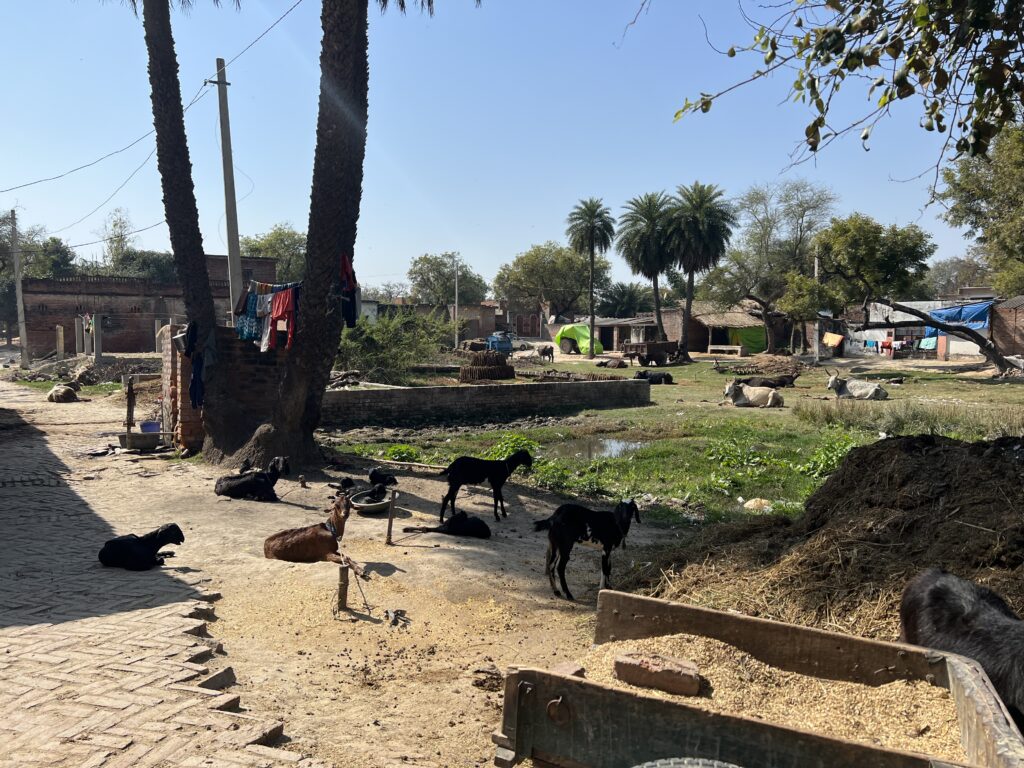
Author’s maternal village, Sirsa near Nawab Ganj, Unnao, Uttar Pradesh, India. February 9, 2023
It was getting dark and they knew it’s time to go home. Bira said: “I asked around. There is no
work available in the vicinity.”
“Yes, I also heard that!” Giva replied. “But Jita said that some construction work may start
down the river next week. So we can only wait”.
“Hmmm…” mumbled Bira as they climbed down the rock and started to walk back to the
shanties. “I don’t think I can spend the day at home. Can we come here early tomorrow?” He
continued.
Giva thought for a while and said: “It’s a good idea. A doctor is visiting the colony tomorrow
morning. I wanted to take Mai to him for her coughing. We can meet in the afternoon. But
what will we do here?”
“It feels so much nicer here.” Bira responded. “And we can try and make a raft with bamboos.
Remember, when we were children, how Kaka and his friends used to make rafts and sail in
the river. We can try and do the same. There is nothing else to do anyway. We can get bamboo sticks and ropes quite easily”.
Giva felt excited: “Yes, let’s do that. I will see you here tomorrow at noon. Let us bring our
food as well.
The two friends met the next day and spent the whole afternoon making a raft. It was hard
work but very enjoyable. At the end of the day, they realized that some more rope and cutting
tools will be required to complete the raft. So, it was decided to complete the raft the next
day. Giva and Bira were so excited that they met at the river early in the morning the next day
and much before noon the raft was ready.
“Shall we give it a try?” Bira asked.
“We will need paddles. Jita has a few of them which his father used when he had a boat. We
will borrow a couple of them tomorrow and venture into the river”, Giva said. Like Bira, he
was also disappointed that their adventure will have to wait for another day. They decided to
meet in the morning the next day with Giva taking the responsibility of acquiring paddles from Jita later in the day.
Bira and Giva were so excited about the ride on the raft that they were at the riverside quite
early the next morning. Armed with a paddle each, they eased the raft into the river and
start to row it away from the shore. The view of the hills and its thick foliage became even
more beautiful as their distance from the shore increased. After a while their shanties on
the hillock also started to look interesting. Abstract art, they say, often looks better from a
distance and even makes one feel aesthetically fulfilled! Just like the elegance of numbers
on poverty and nutrition somehow hide the squalor of poverty and probably make the social
scientists comfortable in dealing with issues faced by the poor.
The two friends kept rowing away from the shore for some time and then suddenly Giva
shouted at the top of his voice: “Stop, stop! Look there, the Forest Rest House on the hill!!
We had once climbed up to that place when we were in school, remember?”
“Of course!” said Bira. “How can I forget that?” “And we could see the bungalow only from
one place in our village!”
“YES!” Giva shouted in excitement, “the mango tree”! “So, we are on top of OUR mango
tree!”
Bira and Giva looked at each other. Their eyes shining and their faces flushed with the effort
of rowing and excitement! During summers, the lone mango tree was the focus of attention
for all the kids in the village who had the ability to ‘pluck’ a mango with a single throw of a stone or a stick. And also, for those who had no such competence. After all, throwing sticks
and stones had a joy of its own, even if it did not touch a mango.
Both of them seemed to be thinking of the same thing as Bira spurted:
“Jita had the best aim in our group. Hira, though good could never come close to him. Isn’t
it?”
Giva smiled and nodded enthusiastically.
The grand old mango tree had lived a long, long time despite being the target of juvenile
violence. It basked in the sun, bathed in the rain, swayed in the breeze, and danced in the
wind. It was privy to many political discussions, social discourses, village gossip and even
furtive romances as the platform around it provided the ideal location for all kinds meetings.
“Remember the meeting held here against the dam, when the Police had come?” It was Giva’s
turn to reminisce now. “We were still in school. There was much shouting and people were
so agitated that the police had to use the lathi-charge to disperse the crowd. All the kids ran
home when the commotion started with the Police going berserk. So many people were
injured. We did not get any food that night!”
Bira listened to Giva quietly and his face became somber. The excitement and cheerfulness
of a few moments ago seemed to be draining from his body. Giva saw this change. He did not want to dwell on that painful phase in their lives and therefore decided to lighten the mood.
He said:
“Remember Bira, Dadu used to say that in his childhood days, the village had a big orchard of
mango trees. Wind aided ‘droppings’ of raw mangoes were enough to satisfy the chutnee and pickle needs of all households of the village. And there were always enough ripe mangoes to suck. Use of sticks and stones to get mangoes was not allowed.”
“Yes, I remember!” Bira came out of his reverie. “Unfortunately, that orchard was first taken
by a thekedar and the villagers lost their supply of mangoes. Later it was eaten up by a
government scheme that never took off!”
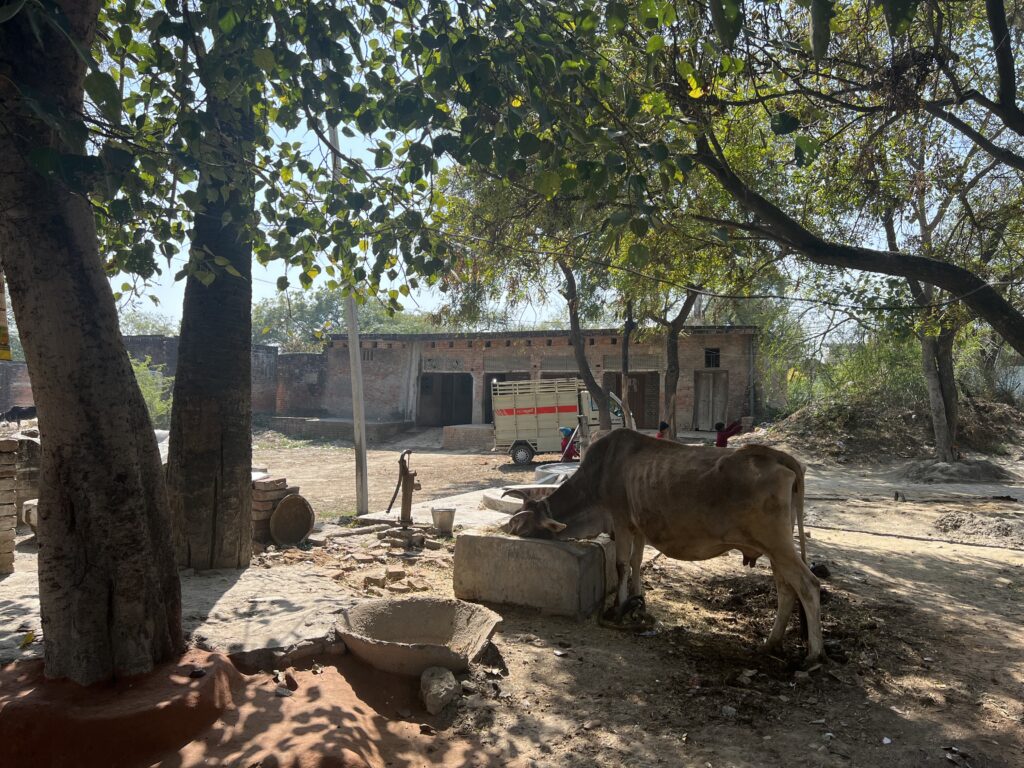
Author’s maternal village, Sirsa near Nawab Ganj, Unnao, Uttar Pradesh, India. February 9, 2023.
Let us move towards our school. It should be about 200 meters to the right in the same line.
And they rowed to the right.
“This should be it, right?” enquired Bira.
“Yes,” Giva said, “we should be on top of the school maidan now. The building should be a
bit further down”.
The two friends floated on top of their school. Old memories came rushing, taking them
back to their school days. And they got lost in their own thoughts.
“Remember?” both said suddenly!
“What?” Giva said smiling.
“No, no, you tell first,” Bira urged him.
Giva started to laugh. “I remembered the day when all of us got diarrhoea after having food
in the school? There was no space in the school toilet and we were all running to the fields
again and again. What a scene it was! We must be suffering a lot then but now when I think
about it, the whole thing seems so funny – people running helter-skelter to shit!”
“Yes, I remember”, Bira added. “All the girls had quickly gone home, boys stayed back but
eventually the school was closed for the day. We never figured out what went wrong but
the cook got a scolding of his life from the principal”.
“What were you going to say?” Giva asked.
Bira was smiling from ear to ear. “I was remembering the day when a couple had come to
our school and gave us a football and a cricket kit – bat, tennis balls and wickets. Many of us
saw them come in with these things as we were playing outside. But the Principal had
promptly put all the stuff under lock and key. After a lot of requests through Dhiren
Masterji, we got the football. The cricket kit was never used till I left school. We always
played with rubber balls and bats made by us from wood planks. I am told that the cricket
kit was used once the new Principal took charge. He apparently was not a khadoos!”
“Ya, but the football was a lot of fun. For several weeks we kept kicking it around and even
played matches with goals made of bamboo sticks, without knowing the rules!” Giva chimed
in.
“I remember that well. And one fine day there was no air in the football and the school did
not have the hand pump to fill it up. The football could not be used for several days till
someone managed to use the cycle pump to fill air!” Bira added.
“Do you think something was going on between Dhiren Masterji and Pushpa teacher?”Giva
asked with a mischievous smile.
“I don’t know”, Bira replied. ”They seemed close though. I wish there was something
between them as they were the best teachers in school. Always helpful and accessible. I
would love to meet them but no one knows where they are. They were both transferred
almost at the same time.”
“I agree”, Giva added. “Remember both of them had come with us to our hamlet when
Raasi, her sister and a few others had dropped out of school. They managed to persuade
their parents to send them back to school.”
Bira nodded his head in affirmation and said: “Yes, Jiva once told me that they did this all
the time. Going to different hamlets to convince parents to keep sending their kids to
school. Ours was the only somewhat large school in the vicinity and they wanted it to be
used by everyone. I also remember that they had protested openly when Tana was beaten up badly by Sanjay Masterji for playing a prank in his class. Tana was also asked to run
around the school ground ten times in the afternoon heat.”
Giva remembered the incident well: “Poor Tana almost fainted. Nobody liked Sanjay Masterji. He could never teach Maths properly and scolded students if they asked questions.
Very few opened their mouths in his class, anyway.”
The friends became silent again. Their faces reflecting a plethora of emotions.
“When did you last go to school, Bira?” Giva broke the silence.
“Hmmm…” Bira came out of his reverie. “I think the last time I went to school was when I
voted. I was voting for the first time and our school was the polling centre for ours and the
surrounding villages. I remember you were also there. It was quite an election with
submergence of the village being a big issue. There was a call to boycott elections. But it was my first time and I wanted to vote. I did not like any of the candidates so I put the stamp on five or six of them!” Bira was laughing now.
Giva nodded, “I think I also never went back to school after that Election Day. In the next
elections we were both in Mumbai and could not vote. And then, of course, the village
ceased to exist and along with it, our school!” Giva’s smile was whimsical.
Let us move now. I think if we go back a bit, we will reach the temple. The friends rowed
back for a while.
“I think, this should be it. If we dive down here, we might be able to see the temple flag and
touch the temple top!” Giva said.
Both the friends looked up and mumbled their prayers. Their faces became calm and serene
for a few seconds. A smile brightened Bira’s face as he said:
“One does not need a temple to feel God’s presence. I just felt I was there in front of the
deity. Interesting, isn’t it?”
“Yes, I agree.” Giva said. “I have always believed that the temple and the God are inside you.
But I have always loved the sound of the bells at the time of aarti. When I was a kid or even
later, I often stood outside the temple when pooja was going on to enjoy that sound. It fills
you and makes you whole in some way!”
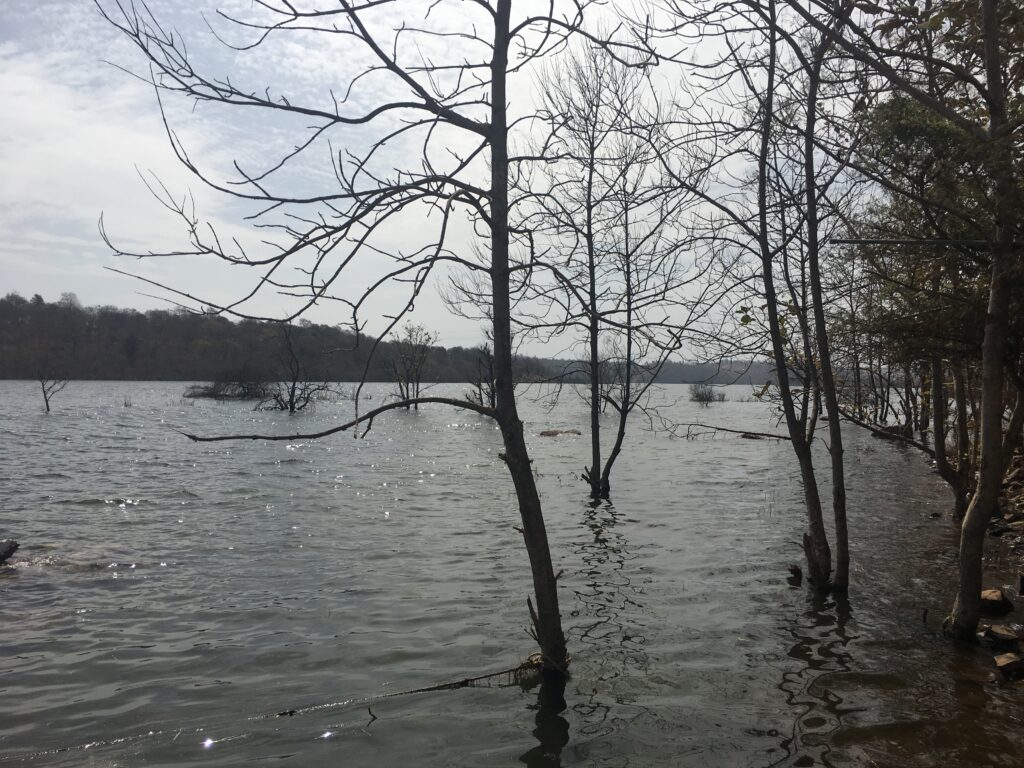
A submerged area near Omkareshwar Dam on river Narmada, Madhya Pradesh, India. February 24, 2019.
“I think you are right although I have not read as many books as you”, Bira said half in jest
and half in seriousness. “I remember, you had read all the books that Pushpa teacher and
Dhiren Masterji had. Our school library was there only on paper!”
Giva felt a bit embarrassed because of Bira’s indirect praise and because he had not read a
book in years! He also felt a bit sad that he could not study further. In order to dispel such
thoughts, he changed the subject.
“This place used to be crazy during the annual mela. The temple and the entire village had a
festive feel at that time. Hordes of people from the surrounding villages used to come and
make the entire area very messy.”
“Surely, the mela was a lot of fun despite all the crowds and the mess.” Bira said.
“Remember, one year someone had stolen Pradhanji’s new shoes from the temple during
the Mela. Baba told me that he was so upset that he did not come to the Panchayat office
for several days. And when he came, he was wearing his old shoes. The Panchayat secretary,
who stayed in the nearby village, innocently asked him: “Pradhanji, what happened to your
new shoes?” Pradhanji went off his kilter and started scolding the secretary for taking too
many holidays and not working properly.”
Giva seemed to be ‘in the middle of the Mela’ reverie. His eyes were unseeing and his face
smiling all over. He said: “It was easy to meet girls during Mela time! So many couples used
this opportunity to spend time together. There were some places behind the temple which
were quite private even during the Mela and the couples took advantage of it.”
“Hahahaha, yes!” Bira agreed. “Jiva once told me that he kissed Raasi for the first time
behind the temple during the Mela festivities. He said they did many more things but did
not elaborate. That was a long time before they got married!”
“Right, we all learnt a lot during Mela time”, Giva commented wistfully.
Bira looked at Giva and smiled. He always expected his friend to make such randomly
meaningful statements in the day to day conversations. Taking his mind away from all
meanings that could be ascribed to that statement, he said aloud:
“Come, let’s now go to the Panchayat Office”.
Giva looked at Bira blankly. So Bira said:
“If we go to the right, we will reach the Panchayat office, correct?”
Giva finally registered what Bira had in mind and they started to move to the right. After a
while, he asked:
“Are we there yet or a bit more?”
“I thinks a few paces more”, Bira said. “I think we have reached now”.
So the raft was parked on top of the Panchayat office. The friends looked at each other and
laughed aloud.
“Are you thinking what I am thinking?” Bira asked.
“I am, if you are thinking of the Panchayat Secretary’s moped episode?” Giva replied.
Both could not resist laughing once again. Still laughing, Bira said:
“I don’t know what came over us that day. Baba had come back from the Panchayat office
looking quite despondent. The Secretary had refused to give him the land certificate one
more time on some flimsy pretext. He was quite upset when he told Mai all about it. The
certificate was very important for getting any compensation from the government for the
loss of land due to the dam. I overheard their conversation and got really angry. Ran to your
house and told you all about it.”
“You were so angry that you could hardly breathe, when you came!” Giva continued the
story. “I remember, our first thought was to catch hold of him when he goes back home that
evening and beat him up. But then we decided to follow another strategy! For one full
week, every day we took the air out from one of the tyres of his moped!”
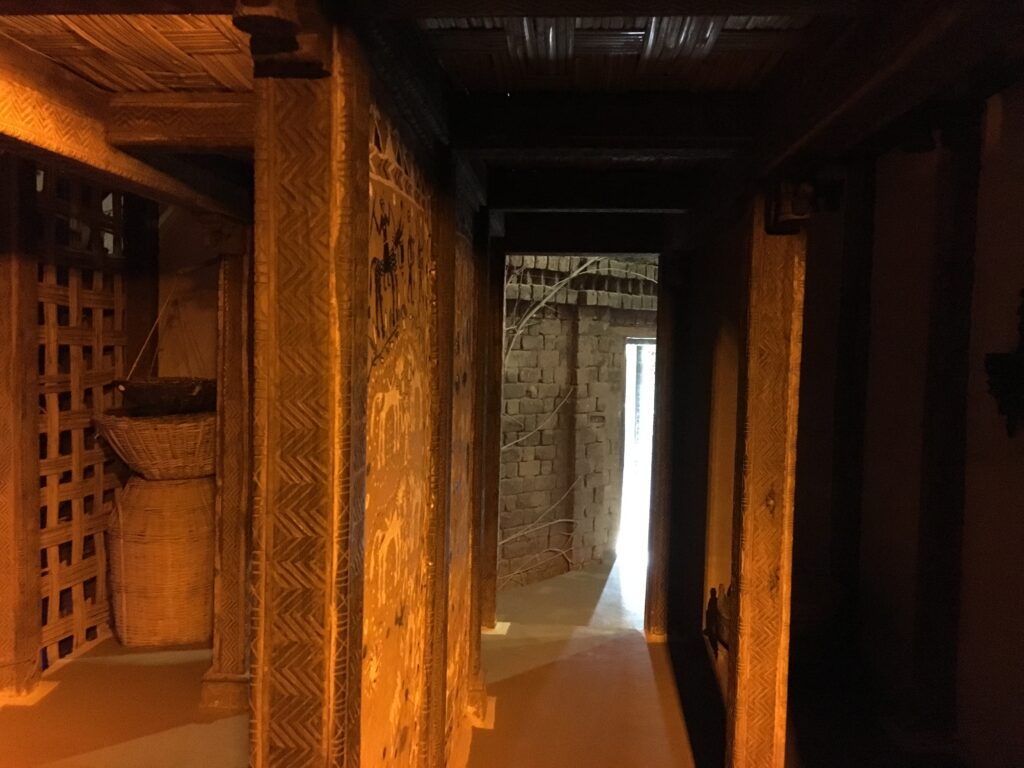
An artist recreation of a traditional tribal house. Tribal Museum Bhopal, Madhya Pradesh, India. February 26, 2019.
“Ya, after the first two days, he started to keep the moped inside the office but we
somehow managed to take the air out when he went to the washroom or just used the nail
to do the trick.” Bira added. “And then we sort of got tired of finding new ways to puncture
his moped!”
Giva was unable to get the Panchayat secretary out of his system and so he said:
“That fellow created so many problems for all the villagers who wanted proof of property
for compensation. The computer was sitting on one of the tables like a showpiece and the
secretary never used it to digitize records. He went for training four times, enjoyed a holiday
and the travel and daily allowance. But learnt nothing.”
Bira decided to add to this serious argument. “Yesterday, Jiva was saying that records are
being computerized in some of the nearby villages so that the farmers can get the benefit of
new technologies. I told him that if the use of computers in these villages is anything like the
one in ours, nothing will come of it. The policy makers are either hysterically daft or
unusually cunning! May be both, if that is possible.”
Giva was looking at his friend in amazement and Bira also felt the burden of his statement
inside him. So, he decided to change the focus of their conversation:
“But Giva, the Mogra and Raat Rani shrubs in front of the Panchayat office were amazing!
Weren’t they? The whole area was full of fragrance when these plants bloomed. We should
have taken those shrubs and planted their cuttings all over our colony. There would have
been some respite from the aroma that we have to suffer now!”
Bira and Giva realised that by now it was quite late in the afternoon. They have been rowing
for a long time which made them very tired and hungry.
“Let’s go back”, Bira said. “It’s quite late now”
“Ok, let us visit the Primary Health Centre (PHC) before we go back. It is just behind the
Panchayat office.”
The two friends rowed a bit more and soon reached the PHC.
“Ours was one of the better PHCs in the area, right?” Bira commented.
“Why not! Your Nurse Didi was there to run the show!” Giva said laughing.
“What yaar! Why are you pulling my leg?” Bira said sheepishly. “I was only trying to help
her. She was trying to do good for us!”
“Of course, you were trying to help her. She was so good looking and you had a big crush on
her. You can never hide anything from me. Your face changed when she was around. Remember when she has just joined the PHC, she had come to school to talk to us!” Giva continued to enjoy Bira’s discomfiture.
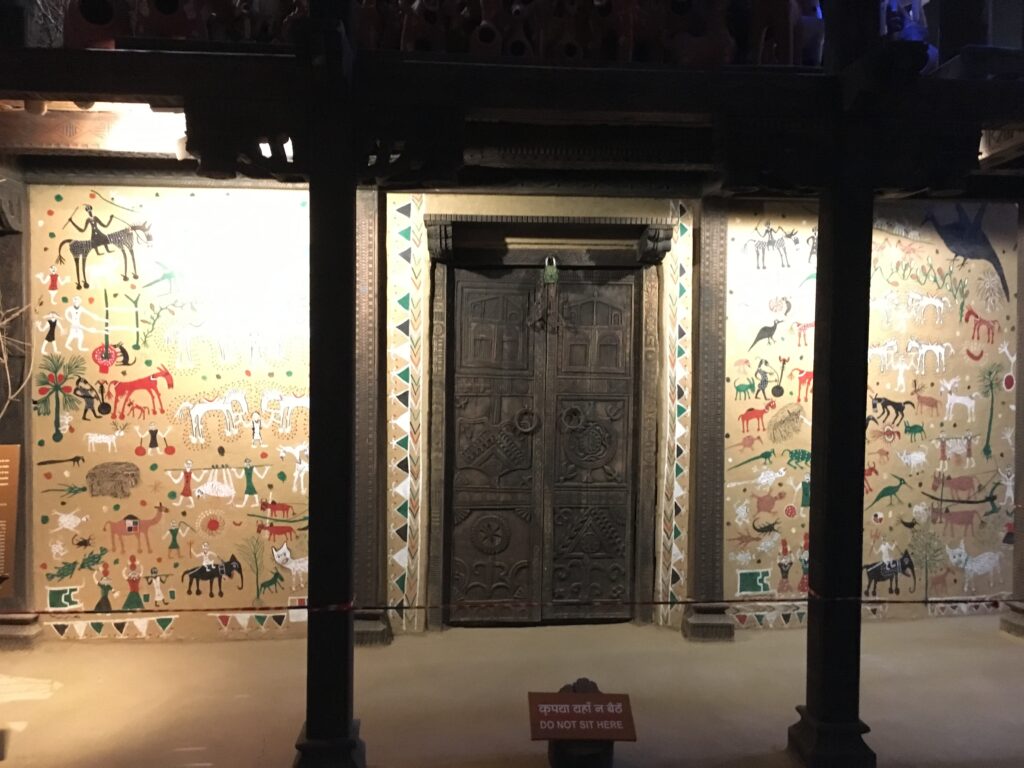
An artist recreation of a traditional tribal house. Tribal Museum Bhopal, Madhya Pradesh, India. February 26, 2019
“Exactly!” Bira desperately tried to defend himself. “She wanted the help of senior students
to spread the word about hygiene and inoculation in the village. Who takes their work so
seriously these days! She had some pamphlets to distribute and had asked us to make some
posters for the school. And I did that. What’s the big deal?”
Giva continued to smile widely and persisted with his relentless ragging: “Yes, yes I know all
that. You made many posters and distributed the maximum number of pamphlets in the
village! Went back to Nurse Didi to get more and more even when it meant that you gave
three pamphlets in each house! Hahahaha!! And how did it feel when she hugged you for
working so hard! You were the only one who got a hug!”
“Come on, Giva, give me a break. I was only 13 years old then!” Bira continued to defend
sheepishly, his face becoming red. He looked at Giva who was still smiling good-naturedly.
He then gave up.
“Okay, you are right. I had a crush on her. Half the boys in our school had a crush on her, at
least among the senior ones! She was so beautiful!”
“And yes,” he continued, “I really liked the hug. She smelled so nice! Happy! Can we go back
now?”
Giva looked at his friend lovingly and said: “Yes, let us do that.”
They turned around the raft and started to row back towards the shore. Throughout the
journey, till they reached the river bank, none of them said a word. Each friend knew that
words would have spoiled their experience of the day. No words were required to relive
their shared experience.
Once they reached the river-bank, the raft was lifted and put in a secure place. Still in
silence they walked back to the colony. As they walked slowly to their homes, both the
friends had their eyes wet and their heart full of all kinds of emotions. Just before splitting
to go to their respective homes, Giva said:
“Let us do this again tomorrow!”
Bira responded eagerly:
“Sure! We will go towards our hamlet. Should be able to find our way once we reach the
forest guest house point!”
Note :- The story was completed in May 2022. Many years ago I had read a story in Hindi (a dialect prevalent in Madhya Pradesh) about youth who try to locate landmarks of their submerged village while rowing a boat in the Narmada river. I have forgotten the name of the story, the author and even the magazine! But the idea stayed with me and evolved into something else as episodes of reverse migration during the Covid pandemic came to light.
I absolutely loved reading this, Prof. It reminded me how much our idea of land ownership has drifted over time. For centuries, we lived in harmony with nature — in small hamlets, surrounded by its abundance, sharing resources and caring for one another as close-knit communities.
We recently moved to Dharamshala, and it’s been such a joy to once again experience the beauty of a high-trust community. Your story brought back so many fond memories of my childhood in a small town in Madhya Pradesh, where everyone knew each other and life felt so deeply connected.